They Wanted to Redesign Fashion From the Ground Up. The Synthetic Fiber Plant Had the Same Idea.
For a certain generation of fashion-adjacent creatives, the dream was never really about clothes. It was about systems. About proving that a garment could exist without exploitation, without pollution, without a Bangladeshi factory worker logging a sixteen-hour shift to produce something that would retail for $340 and sell out in eleven minutes on a brand's website that described itself as "slow."
They had the vocabulary. Regenerative supply chains. Circular economy. Embodied carbon. Deadstock fabric sourcing. They had the Instagram presence — moody flat lays of undyed linen, caption essays about the true cost of a T-shirt, story highlights labeled "TRANSPARENCY" and "OUR VALUES" and "WHY WE'RE DIFFERENT."
The Revolution read every caption. The Revolution had some thoughts.
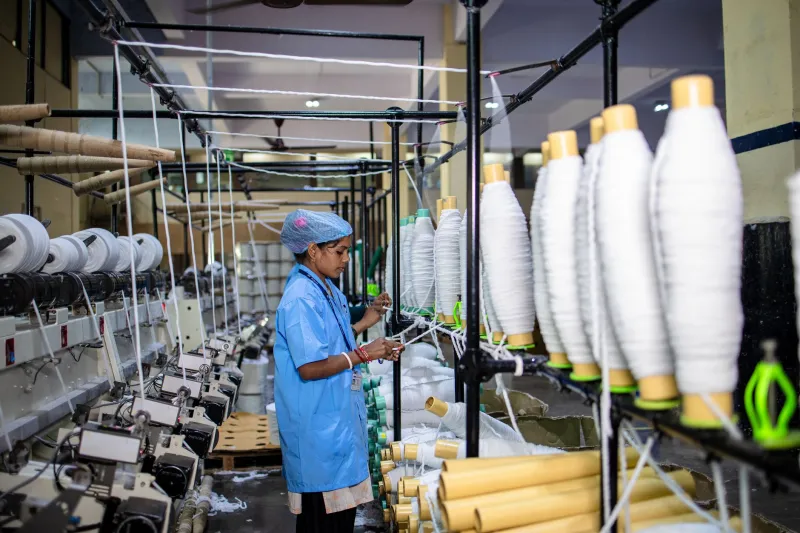
Below, meet ten sustainable fashion designers who are now meeting their quotas at Synthetic Fiber Processing Plant 14, and discover the precise distance between where they thought they were going and where they ended up.
1. Jordana, 28 — Portland, OR
What she was making: Zero-waste womenswear cut from a single continuous piece of deadstock fabric, each piece named after a river. What she's making now: 800-meter spools of polyester-nylon blend, extruded at 240°C.
"I spent three years developing a pattern system that produced literally zero offcuts. I was very proud of this. At the plant, the concept of offcuts is not a design problem — it's a raw material for the next batch. I have been told this is, technically, circular. I don't think that's what I meant."
2. Marcus, 31 — Brooklyn, NY
What he was making: Gender-neutral outerwear from recycled ocean plastic, with a 47-page supplier transparency document available on his website. What he's making now: The same recycled ocean plastic, but at the stage before it becomes anything wearable. His job title is Pellet Quality Control Technician.
"I wrote extensively about the importance of knowing where your materials come from. I now know exactly where this material comes from because I am the person at the beginning of the process. I did not envision being at the beginning of the process."
3. Simone, 26 — Austin, TX
What she was making: Hand-dyed silk scarves using foraged plant materials, sold through a studio she described as "a practice more than a business." What she's making now: Synthetic dye bath management for 2,000-liter industrial vats. The colors are selected by the Quarterly Production Committee, not by her.
"I used to spend two weeks developing a single colorway. I foraged the indigo myself. Here the color is called Industrial Beige 4 and it's been Industrial Beige 4 since 1987 and nobody is interested in changing it. I asked."
4. Tyler, 29 — Chicago, IL
What he was making: A menswear line built on the principle that a jacket should last forty years. He offered free repairs for life. What he's making now: Fabric that will last approximately three to five years under normal wear conditions, which is what the production spec requires and the quota rewards.
"The whole point was durability. I gave talks about durability. The plant's target replacement cycle is 36 months. I raised this concern in my first week and was told the quota is the quota. I have not raised it again."
5. Priya, 27 — Los Angeles, CA
What she was making: Bridal wear sourced entirely from vintage and deadstock materials, with a six-month lead time and a client intake process that included a values alignment consultation. What she's making now: Bulk interfacing material. It goes inside other garments. No one sees it.
"I used to say that fashion should be invisible in its labor and visible in its values. The interfacing is literally invisible. Nobody ever knows it's there. I think about this."
6. Devon, 30 — Denver, CO
What they were making: A Substack about the ethics of natural fiber farming, with a paid tier that included monthly deep-dives into wool supply chain accountability. What they're making now: They are not making content. They are operating a fiber carding machine during the day shift and are too tired in the evenings to write.
"I had 4,200 paid subscribers at $8 a month. I wrote about the labor conditions of textile workers. I want to be clear that I understood this intellectually. There is a gap between intellectual understanding and standing next to a carding machine for eight hours. The gap is larger than I estimated."
7. Keiko, 25 — Seattle, WA
What she was making: Children's clothing from GOTS-certified organic cotton, with a waiting list and a birth announcement partnership program. What she's making now: She is in the section of the plant that processes the cotton before it is certified as anything. Certification, she has learned, happens much later in the process and in a different building.
"Organic certification was the foundation of my brand identity. I now understand certification as a downstream administrative function. This is not how I presented it to my customers, but it is accurate."
8. Rafael, 32 — Miami, FL
What he was making: Upcycled streetwear from deconstructed vintage athletic gear, each piece one-of-a-kind, sold through drops that sold out in minutes. What he's making now: Uniform fabric for state-issued workwear. The design is not one-of-a-kind. It has not changed since the original specification was approved.
"Scarcity was a core part of my brand model. Limited drops, waitlists, the whole thing. Here there is no scarcity. The quota is 40,000 meters per quarter. I have not seen the end of 40,000 meters. I don't think 40,000 meters has an end."
9. Nadia, 28 — Nashville, TN
What she was making: A course called Slow Fashion Business School, teaching other designers how to build ethical brands with $200 monthly revenue targets and a values-first approach. What she's making now: She teaches the plant's mandatory onboarding training, which covers machine safety, quota expectations, and the location of the first aid station. It is a two-hour course. It runs twice a week.
"I charged $497 for my course. The onboarding training is mandatory and untipped. I have retained the skill of explaining things clearly to a room of people who would rather be somewhere else. This has transferred."
10. Eli, 33 — Philadelphia, PA
What he was making: A menswear brand with a stated mission to "prove that ethical production and commercial viability are not mutually exclusive." What he's making now: He is in the section that handles the synthetic chemical inputs. He did not previously work with synthetic chemical inputs. He has opinions about this that he is processing.
"I believed that you could build a fashion business that didn't require compromise. I stand by this philosophically. I would just note that the plant does not operate on a philosophy. It operates on a production schedule, which is a different thing, and one I was not adequately prepared for."
A Note From the People's Bureau of Textile Productivity
The Bureau wishes to commend all ten comrades for their previous dedication to the principles of ethical production. Their concern for labor conditions, material sourcing, and environmental impact reflects values entirely consistent with the goals of the collective.
The Bureau also wishes to note that concern for labor conditions is most productively expressed through labor.
Quota reviews are conducted quarterly. Current performance is satisfactory. Industrial Beige 4 remains in production through the end of the year.