The Central Committee Has Questions About Your Anti-Capitalist Reading List: A Skills Assessment for the Academically Inclined
The Assessment Begins
Professor Elena Martinez built her entire career around talking about work without actually doing any. Her "Radical Labor Studies" book club attracted 847 paying subscribers at $35 monthly, each receiving carefully curated reading lists about "dismantling exploitative labor systems" and access to her monthly Zoom discussions on "post-capitalist workplace organizing."
 Photo: Elena Martinez, via sandiegonav.com
The Central Committee has now completed its comprehensive review of her skill set. The results are illuminating.
The Curriculum Under Review
Elena's book club syllabus read like a greatest hits collection of anti-work literature: "The Conquest of Bread," "Bullshit Jobs," "The Right to Be Lazy," and approximately forty-seven other titles exploring why traditional employment structures oppress the human spirit. Her monthly discussion topics included "Dismantling the Protestant Work Ethic," "Reclaiming Time from Capital," and "Why Productivity Culture Is Violence."
Subscribers paid premium prices to spend two hours monthly discussing how terrible it was that people had to work for money, while Elena collected $29,645 annually for facilitating these conversations from her home office in Portland.
The irony was not lost on the Skills Assessment Committee.
The Practical Application Test
When Elena appeared for her mandatory skills evaluation, the Committee asked a simple question: "Comrade Martinez, in your extensive study of labor systems, have you ever actually labored?"
The transcript of this exchange has become required reading in State efficiency training programs:
Committee: "Your resume indicates fifteen years of 'labor theory education.' Can you describe your personal experience with physical labor?"
Elena: "Well, I've extensively researched the psychological impact of repetitive tasks on worker consciousness—"
Committee: "Have you ever performed repetitive tasks yourself?"
Elena: "I mean, I do repetitive intellectual labor. Grading papers, preparing lectures—"
Committee: "Have you ever used your hands for anything other than typing?"
Elena: "I... garden. Sometimes. I have a small herb garden."
Committee: "How many hours per week?"
Elena: "Maybe... two? When the weather's nice?"
The Committee noted in their report that Elena's "extensive theoretical knowledge of labor exploitation" was paired with "comprehensive practical inexperience with labor of any kind."
The Skills Translation Process
Elena's book club marketing emphasized her expertise in "identifying systemic workplace oppression" and "facilitating critical consciousness about labor conditions." The State decided to test these skills in a more hands-on environment.
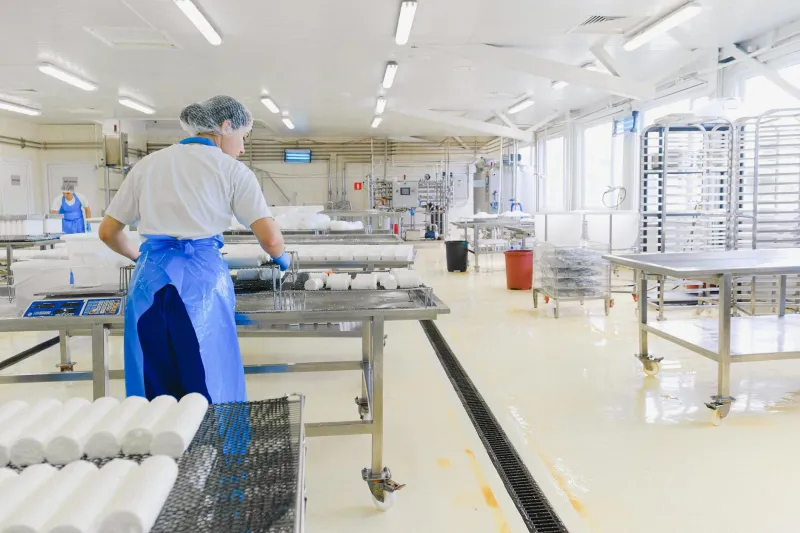
Her new assignment: Supervisor, Night Shift, Coastal Alaska Salmon Processing Facility 17.
 Photo: Coastal Alaska Salmon Processing Facility 17, via nikko-us.com
Welcome to Applied Labor Theory
The Ketchikan Collective Fish Processing Plant operates twenty-four hours daily during salmon season, processing approximately 40,000 fish per shift. Elena's theoretical knowledge about "alienation from the means of production" is about to become extremely practical, as she'll be personally acquainted with every stage of salmon processing from boat to can.
Her job description includes:
-
Quality Control Supervision: Ensuring each fish is properly cleaned, filleted, and prepared for canning. This involves standing for 12-hour shifts in refrigerated facilities, wearing waterproof gear, and developing the kind of hand-eye coordination that comes only from processing thousands of fish.
-
Worker Efficiency Monitoring: The very productivity tracking systems she spent years critiquing in her book club discussions. Elena will now implement them, ensuring her crew meets processing quotas while maintaining safety standards.
-
Equipment Maintenance: The industrial machinery that transforms whole fish into canned salmon requires constant attention. Elena's theoretical understanding of "worker alienation from tools of production" will deepen considerably as she learns to repair conveyor belts, cleaning systems, and packaging equipment.
The Educational Value of Real Experience
Elena's first week reports have been... educational. Her initial enthusiasm for "finally experiencing authentic labor conditions" diminished somewhat after day three, when she discovered that twelve-hour shifts in a fish processing plant don't leave much energy for evening reading.
Her journal entries, now required reading for all book club subscribers, provide unique insights:
Day 1: "This is exactly the kind of authentic working-class experience I've been writing about! I'm finally connecting with the material reality of labor!"
Day 4: "My hands smell like fish. Everything smells like fish. I dream about fish. Why did none of the books mention the smell?"
Day 8: "I've gained profound respect for the physical demands of industrial work. Also, I understand now why workers historically fought for eight-hour days. Twelve hours is... a lot."
Day 15: "I may have romanticized manual labor in my theoretical framework. The romanticism has been processed out of me, along with approximately 47,000 salmon."
Curriculum Updates
Elena's book club continues operating, though with some modifications. Her monthly discussions now include practical segments on "Ergonomics and Repetitive Stress Prevention," "The Economic Reality of Piece-Rate Labor," and "Why Theoretical Critique Without Practical Experience Is Intellectual Masturbation."
Subscriber feedback has been mixed. Some appreciate the "authentic worker perspective" Elena now brings to discussions of labor theory. Others miss the days when critiquing capitalism didn't involve detailed descriptions of fish-processing techniques and industrial safety protocols.
The Six-Month Review
The Central Committee's follow-up assessment notes significant improvement in Elena's practical skill set. She can now:
- Process 340 salmon per hour while maintaining quality standards
- Identify equipment malfunctions by sound alone
- Calculate production efficiency rates in her head
- Lead safety training sessions for new workers
- Repair most conveyor belt problems with basic tools
More importantly, her theoretical understanding of labor has been enriched by direct experience. Her recent essay, "What Marx Didn't Tell You About Fish Scales Under Your Fingernails," has become essential reading in practical labor studies programs.
The New Syllabus
Elena's book club now requires all subscribers to complete monthly "practical labor experiences" alongside their reading assignments. Recent activities include:
- Community garden maintenance (minimum 8 hours monthly)
- Local food service or retail work (at least one weekend shift)
- Manual labor volunteering (construction, cleaning, or similar physical work)
Subscription fees have been reduced to $15 monthly, with the difference made up through subscriber labor contributions to the collective.
Conclusion: Theory Meets Practice
The State's assessment of Elena's transformation has been overwhelmingly positive. Her integration of theoretical knowledge with practical experience has created a more comprehensive understanding of labor systems than either approach could provide alone.
As Elena noted in her most recent newsletter: "I spent fifteen years teaching people to critique work without understanding what work actually entails. Now I critique work from the inside, with fish scales under my fingernails and genuine appreciation for the complexity of industrial labor. It turns out you can't dismantle systems you've never actually experienced."
The revolution continues, comrades. Books remain important, but they're most effective when combined with the kind of hands-on experience that leaves you too tired to read them until the weekend.