The People's Atmospheric Resource Bureau Has Calculated Your Professional Breathing Costs, Comrade
My Name is River, and I Used to Charge People to Breathe
I need to come clean about something. For the past five years, I built what I called a "breathwork empire" in the greater Portland area. I charged $300 per session to guide stressed professionals through what I marketed as "conscious connected breathing experiences." I had a waiting list of 200 people, a beautiful studio space with Himalayan salt lamps, and a income that let me afford a $4,000-a-month apartment in the Pearl District.
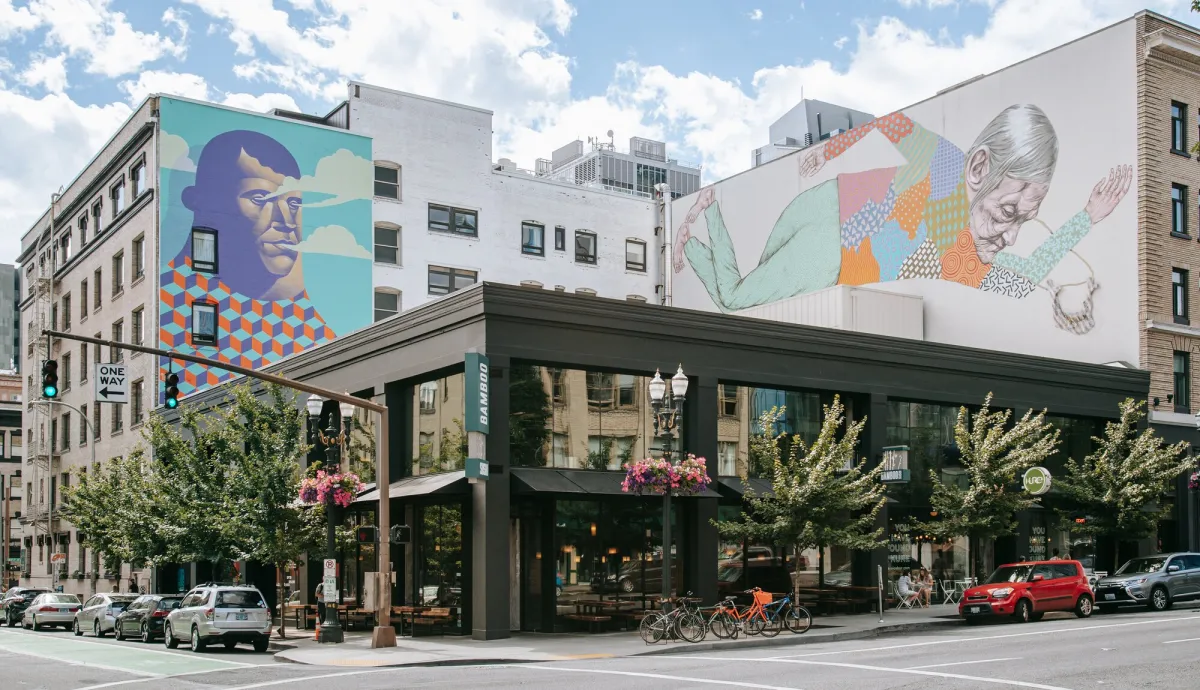 Photo: Pearl District, via a.travel-assets.com
I thought I was healing people. Turns out, I was just really expensive at telling them to inhale and exhale.
The revolution taught me otherwise.
The Business Model (In Retrospect)
Let me break down what I actually did for those five years, now that I have some clarity about it:
I would sit in a room with someone who paid me $300. I would tell them to breathe in for four counts, hold for four counts, breathe out for four counts. Sometimes I'd add music—usually something with Tibetan singing bowls or rain sounds. I'd speak in what I called my "facilitator voice"—slower, softer, more intentional than normal human speech.
"Feel the breath moving through your body," I'd whisper. "Notice how the oxygen connects you to all living things."
For 90 minutes of this, people paid me what most Americans make in a week.
I told myself I was providing a service. I had certifications—$8,000 worth of training in "Transformational Breath Technique" and "Conscious Connected Breathwork." I had testimonials. Sarah from Nike said my sessions "changed her relationship with stress." Marcus from Intel called my work "life-altering."
But when I really examine what I did... I charged people money to use oxygen.
The Audit Letter
The People's Bureau of Atmospheric Resources found me three weeks after the revolution. Their letter was thorough:
"Comrade River Moonchild (legal name: Jennifer Patterson),
Our records indicate you have operated a business charging citizens for breathing instruction over the past 60 months. Our atmospheric accounting division has calculated the following:
- Total sessions conducted: 2,847 - Average session length: 90 minutes - Total professional breathing time: 4,270 hours - Estimated oxygen consumption during paid breathing: 2,135,000 liters - Revenue generated from atmospheric resources: $854,100
The State has some questions."
They wanted to meet.
The Meeting
I sat across from Comrade Vladimir, former life coach turned Atmospheric Resource Administrator, in what used to be a Starbucks. He had my file open—apparently they'd been tracking my business longer than I realized.
"Help me understand your value proposition," Vladimir said, not unkindly. "You charged $300 for people to breathe oxygen that belongs to everyone."
"It wasn't just breathing," I protested. "It was guided breathwork. I facilitated their connection to—"
"To what?"
"To their inner wisdom. Their nervous system regulation. Their—"
Vladimir held up a hand. "Comrade, I used to charge people $400 to help them 'manifest abundance.' I understand the language. But what did you actually do?"
I sat there for a long moment. What had I actually done?
"I... told them to breathe differently?"
"Using air that belongs to the collective."
"Yes."
"For $300 per session."
"Yes."
Vladimir made a note in my file. "The math is concerning, Comrade."
The Calculation
The Bureau's economists had done the work. If you calculate the oxygen consumption of my breathwork sessions and multiply it by the number of people who could have used that same oxygen for free, basic breathing... well, the numbers were staggering.
During my highest-earning month, I'd facilitated 67 sessions. That's 100.5 hours of guided breathing. The oxygen consumed during those sessions could have supported 2,847 people breathing normally for the same time period.
Essentially, I had monetized a basic biological function that every human needs to survive.
"It's like charging people to blink," Vladimir explained. "Except blinking doesn't require a shared atmospheric resource."
The Reassignment
My new job assignment came with a letter of explanation:
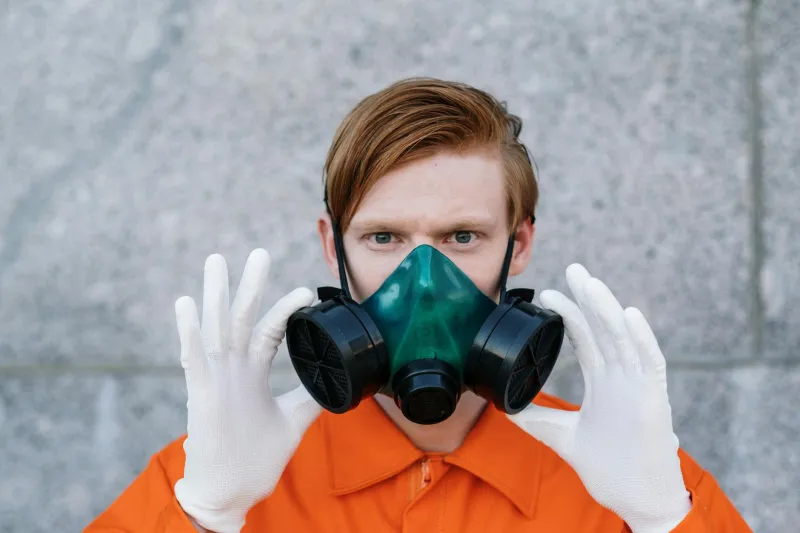
"Given your extensive experience with respiratory function and your familiarity with breathing patterns, you are assigned to Industrial Facility 23, Chemical Processing Division. Your role as Atmospheric Safety Specialist will allow you to continue working with breathing, albeit in a more productive capacity.
Your responsibilities include: - Monitoring air quality in chemical processing areas - Ensuring proper respirator function for 200+ workers - Managing ventilation systems during sulfur compound production - Responding to atmospheric emergencies
Note: This position requires wearing a respirator for 10-hour shifts. You will discover that breathing through a mask while monitoring toxic air quality provides a different perspective on the value of clean, free oxygen."
The irony was not subtle.
Week One at the Chemical Plant
My first day at Industrial Facility 23 was... educational.
I'd spent five years in a studio filled with essential oils and soft lighting, guiding people through "conscious breathing." Now I was in a chemical processing plant where breathing the wrong thing could kill you, and my job was to make sure 200 workers could breathe safely while producing sulfur compounds for agricultural use.
My supervisor, Former Meditation Teacher Boris, handed me a heavy-duty respirator and a manual titled "Atmospheric Safety in Chemical Processing: A Practical Guide."
"Your breathing expertise will be useful here," he said with what I now recognize was gentle sarcasm. "Except instead of charging people $300 to breathe deeply, you'll help them breathe safely while doing actual work."
The respirator was nothing like the Himalayan salt lamps and essential oil diffusers of my former studio. It was heavy, practical, and designed to keep toxic chemicals out of my lungs while I monitored air quality sensors throughout the facility.
The Real Work
By week three, I understood the difference between my old job and my new one.
Old job: "Breathe deeply and connect with your inner wisdom." New job: "The hydrogen sulfide levels in Sector 7 are approaching dangerous limits. All workers need to evacuate until ventilation systems restore safe breathing conditions."
Old job: Soft music, comfortable cushions, people paying me to feel relaxed. New job: Alarm systems, safety protocols, people depending on me to keep them alive.
The work was harder, but it was also... real. When I ensured proper ventilation in the sulfur processing area, 47 workers could breathe safely while producing fertilizer that would help grow food. When I monitored atmospheric conditions and caught a chemical leak early, I prevented 200 people from respiratory damage.
I was still working with breathing, but now it mattered.
The Perspective Shift
Six months into my new assignment, I received a letter from a former client. Sarah from Nike had been assigned to agricultural work in the Central Valley and wanted to "check in on my journey."
She wrote: "I keep thinking about our sessions and how peaceful they were. Do you miss that work?"
I thought about it for a long time before responding.
"I miss the income," I wrote back. "But I don't miss charging people $300 to do something they could have done for free in any park. I spent five years convincing people that breathing required a facilitator, a studio, and a significant financial investment. Now I help people breathe safely while they produce things society actually needs. The work is harder, but it's honest."
The Reckoning
The truth is, I built my entire business on a fundamental absurdity: that breathing—something humans have done successfully for 300,000 years without professional guidance—required my expensive intervention.
I convinced myself I was offering transformation, healing, connection. But really, I was selling people permission to use their own lungs while I provided ambient music and spoke in a soothing voice.
The revolution didn't take away my ability to work with breathing. It just required that my breathing work serve a collective purpose rather than my personal profit.
Now when I monitor atmospheric conditions at the chemical plant, I think about those 2,135,000 liters of oxygen I commodified over five years. That same amount of oxygen now supports workers producing fertilizer, cleaning compounds, and industrial materials that serve actual human needs.
The oxygen still gets used. It just doesn't get monetized.
And honestly? I breathe easier now.