Congratulations on Three Years Auditing Corporate Greenwashing. The Battery Acid Fumes at Recycling Plant 7 Are Extremely Sustainable.
Madison Fleiss, 31, former Ethical Supply Chain Consultant at a boutique sustainability firm in Portland, Oregon, has a very specific brand of expertise. She can tell you — in granular, footnoted, slide-deck-ready detail — exactly what a responsibly sourced lithium battery supply chain should look like. She has audited fourteen corporations on this very subject. She has given talks. She had a LinkedIn banner that said "Systems Thinker. Planet Advocate. Accountability Champion."
The People's Bureau of Material Circularity read all of it. They were, in their words, "deeply impressed."
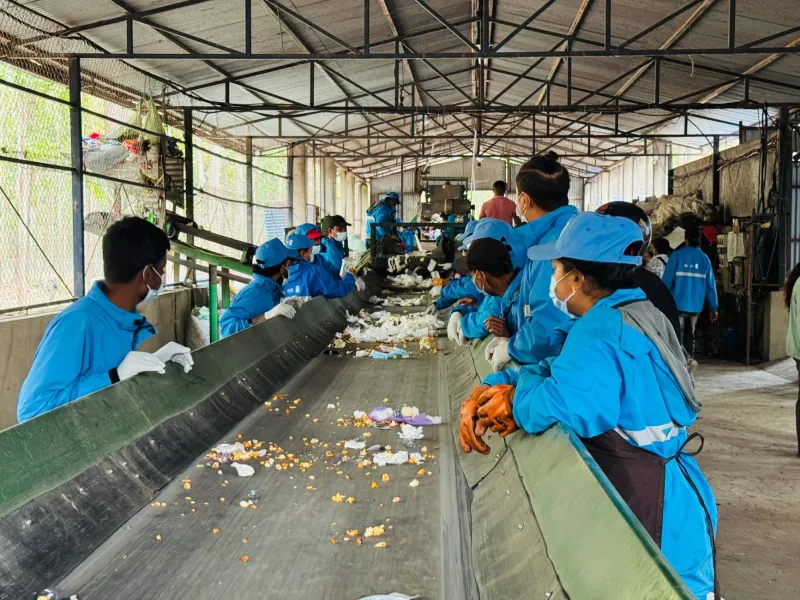
Madison reports to Battery Recycling Facility 7 at 6:15 AM, Monday through Saturday. Her job title is Quality Control Specialist, Grade 2. Her job, in practice, is to stand at a conveyor belt and sort degraded lithium battery cores into one of four bins based on their discharge state, casing integrity, and electrolyte leakage classification. She wears a respirator. She has learned what lithium smells like when it oxidizes. She has opinions about it.
"It smells like ambition," she said, during a brief break period authorized under the Bureau's Mandatory Wellness Minute protocol. "Specifically, like ambition that has been left in a car for three years and started leaking."
The Audit That Audited Back
The sequence of events that brought Madison to Facility 7 is, in the Bureau's assessment, a straightforward example of Relevant Expertise Deployment — the official policy by which the state identifies citizens whose professional background most closely aligns with a critical labor gap and assigns them accordingly.
In Madison's case, the logic is almost elegant. Her three-year body of work documented, in exhaustive detail, that the global electronics industry had no coherent plan for end-of-life battery processing. She cited this as a catastrophic failure of systemic responsibility. The Bureau agreed. The Bureau also noted that someone clearly needed to do the end-of-life battery processing, and that Madison appeared to understand the problem better than almost anyone.
When she raised the possibility that her expertise was more analytical than operational, the Bureau's reassignment officer reportedly paused, consulted a laminated flowchart, and said, "The distinction is not recognized in this column."
Madison's former colleague, Tristan Park, 29, who co-authored several of her audit reports, has been assigned to the facility's incoming materials documentation team. He is logging battery shipments in a climate-controlled room, which Madison describes as "an almost unbearable injustice" given that she specifically wrote the section on upstream sourcing accountability.
The Sustainable Job She Always Wanted (Technically)
Here is what Madison will acknowledge, in her more philosophical moments, usually around hour six of a shift: the work is, by every metric she once used professionally, genuinely sustainable.
The facility operates on renewable energy. Zero discharge goes to landfill. The recovered lithium, cobalt, and manganese re-enter domestic production streams, reducing extraction demand. The supply chain is, by design, entirely traceable — she can account for every cell that passes her station. She has, in a very literal sense, achieved the fully transparent, closed-loop, circular-economy processing model she spent three years telling Fortune 500 companies they needed to build.
"I know," she says. "I know."
She has stopped saying it out loud because her shift supervisor, a compact and cheerful man named Dmitri who has never once heard of a TED Talk, finds the observation confusing and slightly threatening.
What the Reports Left Out
Madison's audit work was thorough. Her reports covered extraction ethics, transport emissions, worker safety standards in overseas processing facilities, and the regulatory gap in domestic recycling infrastructure. They were well-sourced. They were, her former clients agreed, very difficult to read without feeling guilty.
What the reports did not cover, she now admits, was the texture of the work. The way a conveyor belt sounds after four hours. The specific quality of fluorescent lighting in a space large enough to land a regional jet. The fact that battery casing integrity is not always visually obvious and must sometimes be determined by a combination of weight, flex, and what she has come to call "the feeling."
"I wrote 200 pages about this industry," she said. "I did not write one sentence about what it actually feels like to be inside it. That was probably a gap."
The Bureau, for what it's worth, agrees. They have added a note to her personnel file describing her as "a quick adapter with strong theoretical foundation." This is, in the Bureau's internal rating system, a compliment.
A Note on Career Trajectory
Madison is eligible for review in eighteen months, at which point she may apply for a Grade 3 classification, which involves less conveyor work and more spectrographic equipment calibration. She has been told this is considered a desirable outcome. She has been told that several Grade 3 specialists came up through Quality Control and now manage entire processing wings.
She has been told, in other words, that there is a path. It is a longer path than the one she had in mind, and it smells different, and it starts at 6:15 AM. But the Bureau would like her to know it is there.
Her LinkedIn banner currently reads nothing, because LinkedIn has been reclassified as a bourgeois self-promotion platform and her account access has been suspended pending ideological review.
The Bureau considers this a reasonable trade for a fully circular battery economy.
Madison is, by most accounts, coming around.