The Collective Has Reviewed Your 'Boundary-Setting Practice' and Would Like to Introduce You to a Shared Outhouse With Forty-Seven Strangers

From Sacred Space to Shared Space
Madison Rivera had built an empire on the word "no." Her Instagram bio read "Boundary Coach | Sacred Space Curator | Teaching You That No Is a Complete Sentence." Her $400 workshops sold out monthly, filled with millennials desperate to learn the revolutionary act of declining brunch invitations without writing a three-paragraph apology email.
 Photo: Madison Rivera, via m.media-amazon.com
"Your energy is sacred," Madison would tell her clients, gesturing toward the ring light illuminating her perfectly minimalist apartment. "You are not required to explain yourself to anyone. Your space, your rules."
The irony was not lost on the People's Housing Distribution Committee when they reviewed her file.
The Sacred Art of Saying No (Terms and Conditions Apply)
Madison's boundary-setting empire had three pillars: energetic protection, space sanctification, and what she called "radical self-preservation." She charged $150 for a PDF titled "Protecting Your Energy in a Toxic World" and another $200 for a course called "Creating Sacred Space in Chaotic Times."
Her apartment was a shrine to solitude: white walls, plants that required minimal interaction, and a meditation corner where she filmed content about "choosing yourself daily." She had a waiting list for her "Soft Life Bootcamp," where she taught other women how to say no to overtime, family drama, and any social obligation that didn't "spark joy."
"Boundaries aren't walls," she'd say in her TikToks, which regularly hit 100K views. "They're gardens. And gardens need tending."
The Revolution, as it turned out, had different ideas about gardens.
Welcome to Collective Living, Comrade
The Housing Distribution Committee's letter arrived on a Tuesday. Madison read it three times, certain there had been a mistake.
"Comrade Rivera," it began, "your application for individual housing has been reviewed and denied. Your assigned accommodation is Collective Dormitory Unit 47-B, Bunk 23. Orientation begins Monday at 0600."
 Photo: Collective Dormitory Unit 47-B, via i.pinimg.com
Madison immediately tried to apply her boundary-setting techniques. She called the number listed, prepared to explain that she was a small business owner, that she needed quiet space for her work, that her mental health required—
"Comrade," the voice on the phone interrupted, "your mental health will improve significantly once you embrace the joy of communal living. No further appeals will be processed."
The line went dead.
The People's Hygiene Committee Has Thoughts
Collective Dormitory Unit 47-B housed 48 women in a converted warehouse. Madison's bunk was a top bunk, naturally, because the Revolution had reviewed her file and determined that someone who charged $400 to teach people to say "no" probably needed to learn to say "yes" to whatever life handed her.
The bathroom situation was... comprehensive. One large room with 12 toilet stalls, 8 shower stalls, and a sign-up sheet managed by the People's Hygiene Committee. Madison stared at the schedule in horror: bathroom time was allocated in 15-minute slots, shower time in 10-minute increments, and "personal grooming activities" were limited to three minutes per session.
"Comrade Rivera!" called Svetlana, the dormitory's Collective Living Coordinator, spotting Madison's obvious distress. "You look concerned. Remember, in true communist society, privacy is bourgeois concept. We share everything here!"
Madison opened her mouth to explain that she needed at least 30 minutes for her morning routine, then caught herself. The old Madison would have launched into a speech about self-care and non-negotiable morning practices. The new Madison—the Madison who lived in Collective Dormitory Unit 47-B—was learning that negotiation was no longer on the table.
Sacred Space Meets Shared Space
The meditation corner situation proved even more challenging. Madison had requested a quiet space for her "spiritual practice," which the Collective Living Committee had enthusiastically approved. They assigned her a corner of the common room—the same corner where Comrade Olga practiced accordion at 6 AM, Comrade Chen led group calisthenics at noon, and the entire dormitory gathered for mandatory evening political education sessions.
"Is beautiful, no?" Svetlana beamed, gesturing at the corner where Madison's meditation cushion sat between a set of dumbbells and a poster reading "THE PEOPLE'S STRENGTH IS IN UNITY." "You wanted sacred space, we give you most sacred space of all—space shared with 47 sisters!"
Madison's first attempt at morning meditation was interrupted by Comrade Olga's rendition of "The Internationale" and three different women asking if she was done with her "floor time" because they needed to do their exercises.
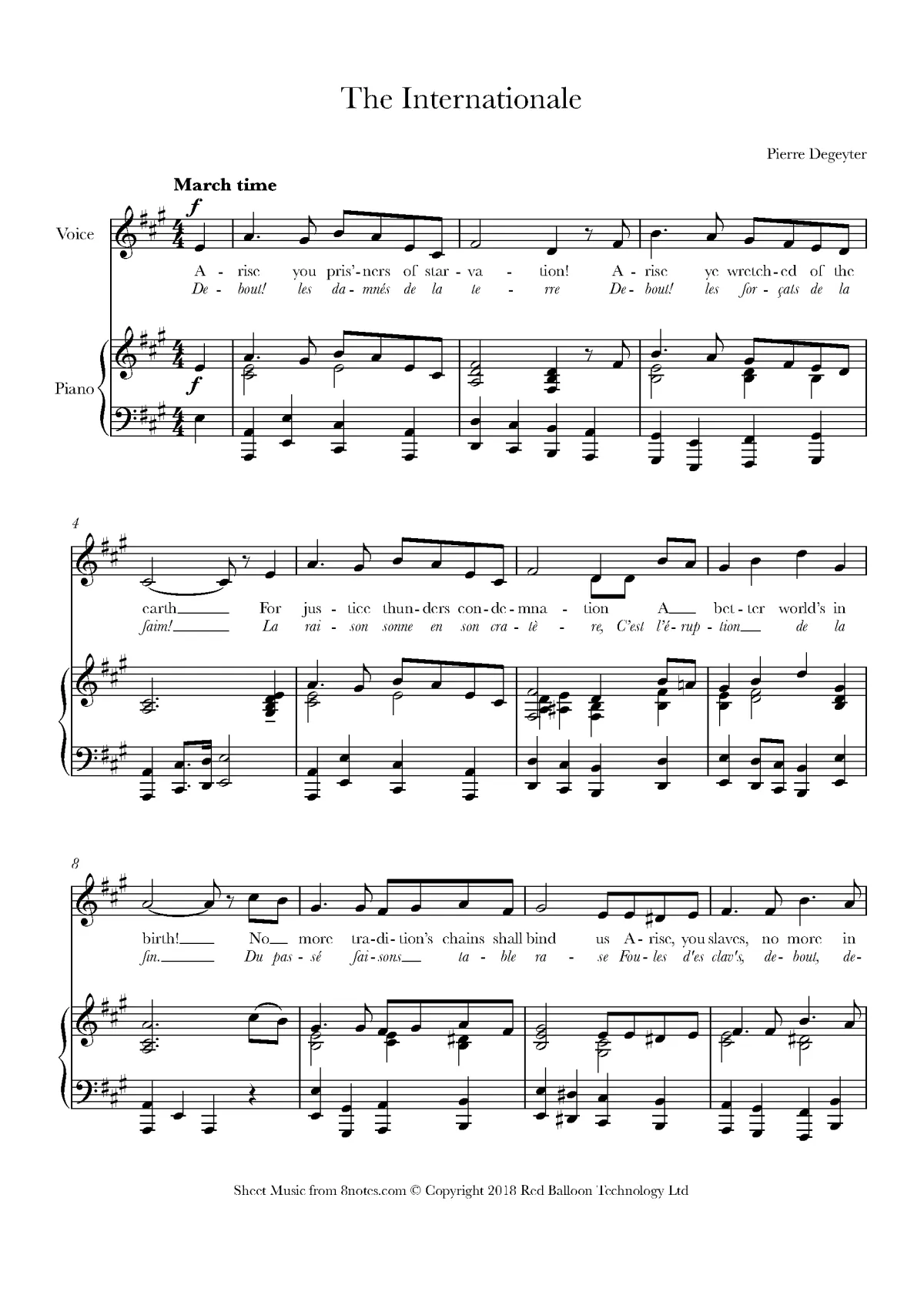 Photo: The Internationale, via www.8notes.com
Her second attempt was cut short when the Collective Activities Committee informed her that individual meditation was "ideologically suspect" and she should join the group breathing exercises instead.
By day three, Madison had stopped trying.
The Boundary Coach Learns About Boundaries
The most brutal revelation came when Madison tried to apply her professional expertise to her new living situation. She attempted to set boundaries around her bunk space, requesting that her bunkmate respect her "energetic bubble."
Comrade Anya, a former steelworker who now managed the dormitory's conflict resolution process, listened patiently to Madison's explanation about personal energy and space sanctification.
"Comrade Rivera," Anya said gently, "I think you misunderstand purpose of boundaries. In capitalist system, you build walls to keep people out, yes? In socialist system, we build bridges to bring people together. Your energy belongs to collective now. Is much better this way."
Madison tried to explain that boundaries weren't about keeping people out, they were about—
"About what, Comrade? About charging $400 to teach people to be selfish? About making sacred space so sacred that no one else can enter? About teaching women that caring for others is toxic?" Anya's voice remained gentle, but her words hit like a sledgehammer. "Revolution has reviewed your boundary practice, Comrade Rivera. We have some suggestions."
The New Sacred Practice
Six weeks into collective living, Madison's Instagram account had been reassigned to the People's Social Media Collective. Her final post, written by the Committee for Digital Wellness, read: "Learning that true boundaries aren't about keeping others out—they're about letting the community in. Excited to announce my new workshop: 'Yes Is a Complete Sentence: Embracing Collective Joy.' Sliding scale pricing: one turnip to attend."
The comments were disabled, naturally. Individual responses to collective content had been deemed "unnecessarily divisive."
These days, Madison wakes at 5:30 AM to the sound of 47 other women beginning their day. She waits in line for bathroom time, shares her morning coffee with whoever needs it, and has learned that her meditation practice works just fine with accordion accompaniment.
She still teaches workshops, though the content has evolved. Last week's session was titled "Setting Boundaries Around Your Individualism: A Group Discussion." The sliding scale fee is now one turnip, and attendance is mandatory.
The Revolution, it turns out, had its own ideas about what constituted a complete sentence. And that sentence was: "Yes, Comrade. Whatever the collective needs."
Madison is still learning to find it sacred.